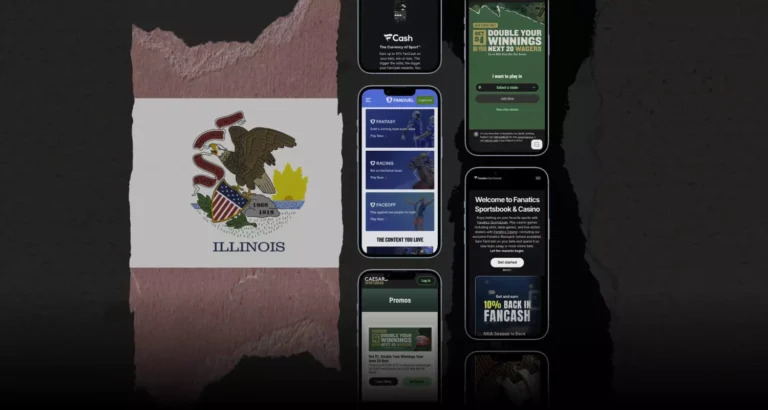
Don’t miss these selected Illinois sportsbooks
Best Betting Promos from Online Sportsbooks in IL
Free Bets are plentiful for newcomers. Take for example, FanDuel which new users who win their first $5 bet $300 in free bets. Hard Rock’s offer is more modest – win your first $5 bet, get $150 in bonus bets.
On the flip side, Fanatics is offering Illinois bettors up to $100 back in FanCash – for use for items such as official team merchandise – if your first bet loses.
| Sportsbook |
Welcome bonus |
Popular markets |
| BetMGM |
Up to $1,500 in bonus bets if the first bet loses. |
NFL, NBA, MLB, NHL, College Football & Basketball |
| Caesars |
Bet $1, double your winnings on your next 20 bets |
NFL, NBA, MLB, NHL, College Sports, Golf |
| FanDuel |
Bet $5, get $300 in bonus bets if your bet wins |
NFL, NBA, MLB, NHL, Soccer, College Sports |
| Fanatics |
Bet $50, get $250 in FanCash |
NFL, NBA, MLB, NHL, College Football & Basketball |
Illinois Betting Overview
No state in the heartland of the country has taken more bets than Illinois – $51.9 billion through August 2025. Meanwhile, the state ranks second to New York to that point in sportsbook revenue – $4.4 billion – and in tax collected – $933.6 million. Illinois sportsbooks have had a “hold” rate of 8.4%, just a tick below the national average.
| Live Since: |
March 9, 2020 for retail sportsbook and June 18, 2020 for mobile books |
| Total Online Books: |
10 |
| Total Retail Books: |
12 |
| Handle & Revenue: |
The Illinois betting handle in 2024 was $14 billion, leading to $1.2 million in revenue – the latter figure up almost 20% versus 2023. |
| Sports Betting Tax Rate: |
ranges from 20% for small operators to 40% for large ones |
| Legal Betting Age: |
21+ |
Best Online Sportsbooks in Illinois: Two operators dominate the playing field
DraftKings tends to edge out FanDuel in betting handle in most states, and Illinois results tend to be no different in that regard. DraftKings typically manages to take 35% to 40% of a state’s market share, with FanDuel just behind. In August 2025, the pattern remained as DraftKings recorded $38.1 million in revenue while FanDuel slightly trailed at $34.3 million.
Another trend that holds up in Illinois as well as in the U.S. is FanDuel consistently being even more competitive in terms of the “hold” rate on wagers. That’s because FanDuel was first-to-market six or seven years ago in terms of aggressively marketing same-game parlays. Those bets offer alluring odds to optimistic gamblers, but the rate of payback to customers sometimes lands only around 80%, while sportsbooks sometimes turn over 95% or more on single-game wagers.
List of Online & Retail Betting Sites in Illinois
There are currently 10 online sportsbooks and 12 retail sportsbooks live in Illinois.
Online Sportsbooks and Official Launch Dates
- BetRivers – June 18, 2020
- DraftKings – Aug. 5, 2020
- FanDuel – Aug. 28, 2020
- BetMGM – March 5, 2022
- Caesars – March 9, 2022
- Circa Sports – Sept. 9, 2023
- ESPN Bet – Nov. 15, 2023
- Fanatics – April 5, 2024
- Hard Rock Bet – Aug. 6, 2024
- Bet365 – March 16, 2025
Retail Sportsbooks and Official Launch Dates
- Bet Rivers at Rivers Casino (Des Plaines) – March 9, 2020
- Argosy Casino Alton – March 12, 2020
- Caesars at Grand Victoria Casino (Elgin) – Aug. 3, 2020 (as William Hill Sportsbook; replaced by Caesars Aug. 5, 2022)
- FanDuel Par-A-Dice Sportsbook (East Peoria) – Sept. 9, 2020
- FanDuel Sportsbook & Horse Racing (Collinsville, formerly called Fairmount Park)
- Fanatics Sportsbook at Hawthorne Race Course (Stickney) – Sept. 30, 2023 (as PointsBet; replaced by Fanatics April 5, 2024)
- DraftKings at Casino Queen (East St. Louis) – March 29, 2023
- DraftKings at Wrigley Field (Chicago) – Aug. 27, 2023
- Circa Sports at American Place Casino (Waukegan) – Oct. 2, 2023
- Bally Bet at Quad Cities Casjno – Dec. 28, 2023
- Hard Rock Casino Rockford – Aug. 29, 2024
- Hollywood Casino Joliet – Aug. 12, 2025
What You Can Legally Wager On in the Prairie State
Ilinois regulators have approved dozen of sports for wagering, from traditional staples like football, baseball, basketball, and hockey to more exotic options like sailing, surfing, cycling, rugby, darts, and cricket.
Official Sports Teams to Bet On
Chicago is home to all of the state’s traditional major sports franchises – the Cubs and White Sox in MLB, the NFL’s Bears, the NHL’s Blackhawks, and the NBA’s Bulls.
The University of Illinois, Northwestern, and Northern Illinois are the state’s Division I college football teams. There are seven other schools that also compete in D-1 college basketball: Bradley, Chicago State, DePaul, Eastern Illinois, Illinois-Chicago, Illinois State, Loyola, Southern Illinois, Southern Illinois-Edwardsville, and Western Illinois.
Can You Bet on In-State College Sports?
Illinois does not allow its sportsbooks to offer wagering on in-state college team results or on in-state college individual prop betting.
In August 2025, the Illinois Gaming Board announced that it would even prohibit gambling ads and promotions on college campuses, including student TV stations, radio stations, and journalism outlets.
Since the state launched the sports betting in 2020, it has wavered on whether to allow betting on in-state teams. All such bets at first were banned, then permitted but only at retail casinos, and finally banned again in mid-2024. That sort of indecisiveness is not typical of U.S. state regulatory bodies.
Other Things You Can’t Bet On
The long list of authorized sports available for wager does not include anything other than the games themselves. So no betting in Illinois on Super Bowl props such as the length of the pre-game national anthem or what color of Gatorade gets dumped on the winning coach in the post-game celebration; no Academy Award or Emmys bets; and no wager on the Nathan’s Famous Hot Dog Eating contest.
Illinois vs Neighboring States – #3 U.S. State in All-Time Betting Handle
Illinois boasts a robust third nationally in all-time handle at $50.9 million through August 2025, even though the spring 2020 launch of the first sportsbook in the state allowed some states to get a head start of a year or more.
Neighboring Indiana at $23.4 billion, Michigan at $22.4 billion, and Ohio at $21.8 billion rank 9th, 10th, and 11th respectively so far, while Iowa at $12.8 billion and Kentucky at $5.1 billion can’t quite measure up. Wisconsin only allows for wagers on-site at tribal casinos. That undoubtedly modest revenue number is not revealed by Wisconsin regulators who don’t separate out what part of the $66.4 million collected by the state from the tribes was attributable in 2024 to sports betting.
Illinois sportsbooks will see a minor hit to their betting handles when Missouri – including St. Louis on the two-state border – finally launches on Dec. 1, 2025.
When and How Sports Became Legal in Illinois
The lawmakers and regulators in Illinois lagged for just over a year after the U.S. Supreme Court decision in mid-2018 that opened up a legal sports betting option for any state that wanted it, due to differences of opinion about wording in any bill that authorized it.
2019-2020
- June 28, 2019 – Gov. J.B. Pritzker signs the Illinois Sports Betting Act into law, repealing the state’s prohibition on such wagers.
- March 9, 2020 – The first retail casino begins taking bets – Rivers Casino in Des Plaines.
- June 18, 2020 – The first online sportsbook is launched – BetRivers.
2022-2023
- March 5, 2022 – A curious part of Illinois law finally went away as gamblers in the state finally could sign up for sportsbooks without having to physically visit a casino.
- Nov. 15, 2023 – ESPN Bet launches its mobile app in Illinois.
- March 18, 2023 – A DraftKings Sportsbook adjacent to iconic baseball stadium opens for retail wagering nearly a year after it opened with food and drink service.
2024-Present
- April 5, 2024 – The Fanatics online sportsbook debuts, four months ahead of Hard Rock Bet on Aug. 6.
- July 1, 2024 – The gaming board announces that a loophole – allowing for wagers on in-state college games at retail casino sites – had been closed.
Thoughts about IL’s Sportsbook Launch
As it turned out, the first retail sportsbook in Chicago opened only two days before the NBA decided to cancel the rest of its season due to COVID-19 as the World Health Organization officially declared a pandemic.
Within a week, countless businesses and schools across the U.S. were forced to close. That meant that the Illinois retail casinos were unable to claim its share of mobile betting revenue until the first such sportsbook launched more than three months later – just a few days before state health officials allowed the brick-and-mortar casinos to reopen.
The timing sequence proved unfortunate.
Illinois Sports Betting Revenue & Handle
Illinois’s relatively high tax rate, the size of its population, and the broad popularity of both pro and college sports has enabled it to be the envy of most in terms of its overall numbers.
| Total Handle to Date: |
Illinois residents and visitors to the state have wagered $51.9 billion through August 2025. |
| Tax Revenue to Date: |
Illinois has taken in $9.33.6 million in sports betting tax through August 2025, with the tax rate more than doubling for its largest sportsbooks from 15% to 40% as of mid-2024. |
| Breakdown of Online vs. Retail Share |
Mobile sportsbooks accounted for 98.2% of all sportsbook handle in August 2025- a slightly higher percentage than is typical in other states. |
| YoY Growth Rates: |
The key number here is the annual tax revenue, which ballooned in 2024 because of the massive tax rate increase ahead of the lucrative college and pro football seasons. So after taking in $150.3 million in 2023, that figure skyrocketed to $263.4 million in 2024. |
| Handle Milestones |
Illinois racked up its first $1 billion handle month in October 2022, the state reached the $1 billion-plus mark every month from September 2024-May 2025. That figure is certain to be reached in the last four months of 2025 as well. |
Understanding Sports Betting Taxes in Illinois – Taking Taxation To The Outer Limits
In mid-2024, Illinois lawmakers changed a previously manageable 15% tax on sports betting gross revenue to a five-tier system that hit the smallest sportsbooks with a 20% tax rate, going up to 25%, 30%, 35%, and 40% – the latter only impacting industry giants FanDuel and DraftKings.
Then in mid-2025, the same lawmakers added another tax – 25 cents per bet for the first 20 million wagers, 50 cents per bet after that figure is reached. FanDuel soon announced a 50-cent surcharge to its gamblers on all bets in the state, and DraftKings executives say they are weighing their options. ESPN Bet, meanwhile, raised its minimum bet from 10 cents to $1 in response.
In announcing his proposed 2026 budget in October 2025, Chicago Mayor Brandon Johnson recommended a new 10.25% tax on sports bets taking place in his city. That led several legislators to sponsor a bill banning any city or county from tacking on to the tax rate already imposed at the state level. If Johnson’s effort succeeds, Illinois would take over as the state taxing its sportsbook more heavily than any others in the U.S.
Official Team and Sportsbook Partnerships
Illinois state boasts a handful of partnerships between its Chicago-based teams and popular sportsbooks operating within the state.
- Chicago Bulls x FanDuel
- Chicago Blackhawks x FanDuel
- Chicago Cubs x DraftKings
- Chicago White Sox x Caesars
- Chicago Bears x ESPN Bet
There are also partnerships between sportsbooks and casinos, which are reflected in the name of the establishment themselves:
- Rivers Casino x BetRivers
- Caesars at Grand Victoria x Caesars
Licensing & Oversight – Illinois Gaming Board Looking Out for You Since 1990
The Illinois Gaming Board oversees not only sports betting, but also casino gambling as well as approximately 9,000 video gaming locations across the state.
The board has been in existence longer than all but of a handful of similar U.S. agencies, having been established in 1990 when Illinois became just the fourth state to legalize casino gambling. The Governor selects the five board members, subject to the consent of the Senate.
Responsible Gaming Resources in IL
The board’s website is unusual in that it lists more than just in-state resources designed to help compulsive gamblers get the treatment they need.
- Gambling Anonymous National Office: (909) 931-9056
- Gambling Anonymous National Hotline: (855) 222-5542(Serving Illinois, Indiana, Missouri and other states)
- Gam-Anon National Office: (718) 352-1671
- Gam-Anon Illinois Hotline: (708) 802-0105
- National Problem Gambling Helpline: 1-800-GAMBLER (1-800-426-2537)
The board implemented the Self-Exclusion Program (SEP) in 2002, at the time allowing individuals who have determined they are problem gamblers to exclude themselves from all casinos in the state.
Then the Sports Wagering Act became law in mid-2019, expanding the program to include sports wagering. Gamblers must enroll in the Self-Exclusion Program in person, at various sanctioned enrollment sites throughout the state.
Pros & Cons of Sports Betting in Illinois: A Recap
-
5 top Chicago-based professional sports franchises with solid fan bases
-
Full range of sportsbooks
-
No betting on in-state college sports
Top Reasons to Bet in Illinois
- All five of the Chicago professional sports franchises have devoted fan bases dating back many decades. So while they collectively have not come close to a championship in recent years, fan loyalty has not waned.
- While the University of Illinois has won only one Big Ten football title in 35 years, the city of Chicago is large enough that alumni of every Big Ten team have a presence in the city – including perennial national title contenders Ohio State, Michigan, and Penn State. So the ban on betting on Illinois teams doesn’t mean that there aren’t plenty of Illinois residents who enjoy wagering on their favorite college team.
- The state offers the full range of major sportsbooks, so those with allegiances to daily fantasy sports companies or traditional casino operators and other sports-related busineses can maintain their allegiance to those operators as they make their wagers.
Top Reasons Not to Bet in Illinois
- Sports bettors in their early 20s may not have the same level of loyalty to Chicago pro sports teams as their parents and grandparents, since they haven’t experienced the sort of team success that their elders can remember.
- Illinois goes further than many states regarding a ban on betting on college sports, not only banning individual player props but also forbidding any wagers on in-state college teams at all. That means that if there is a repeat of Loyola’s miracle run to the men’s basketball Final Four in 2018, many residents undoubtedly will turn to unlicensed books.
Closing Thoughts on Illinois Sports Betting: A Moving Target
Will Illinois be the first large state to “kill the golden goose” – or at least wound it ?
The example of New York’s astonishing 51% tax rate on sports betting in a competitive marketplace emboldened Illinois in 2024 to jack up its tax rate from 15% to 40% on market industry leaders FanDuel and DraftKings. But now the mayor of Chicago wants to add his own 10.5% tax rate on top of that, moving Illinois to the top of the national sports betting tax rate rankings if successful.
Illinois also has a massive budget deficit, and it’s clear that state lawmakers see sportsbooks as “easy money,” in the sense that it amounts to a voluntary tax only on gamblers in the state. But presumably there is a breaking point in the national sportsbook industry on taxes – even if we haven’t seen it take place yet.
Don’t miss out on these premier betting bonuses
FAQ: Illinois Sports Betting
Is sports betting legal in Illinois?
Yes, sports betting is legal in Illinois. The state legalized retail and online sports betting in 2019, and sportsbooks launched in 2020.
Can you use FanDuel in Illinois?
Yes, you can use FanDuel in Illinois. The popular online sportsbook launched in the Prairie State in August 2020 and currently partners with Fairmount Park Racetrack.
What is the Illinois online sports gambling tax?
Illinois taxes online sportsbooks on a progressive scale from 20% to 40% of their adjusted gross revenue. The more a brand makes, the higher the tax rate.
What are the best sites for online sports betting in Illinois?
The best sites for online sports betting in Illinois are BetMGM, Caesars, FanDuel, and Fanatics. Each one is licensed and regulated in the state and also offers mobile betting apps.
Related Posts