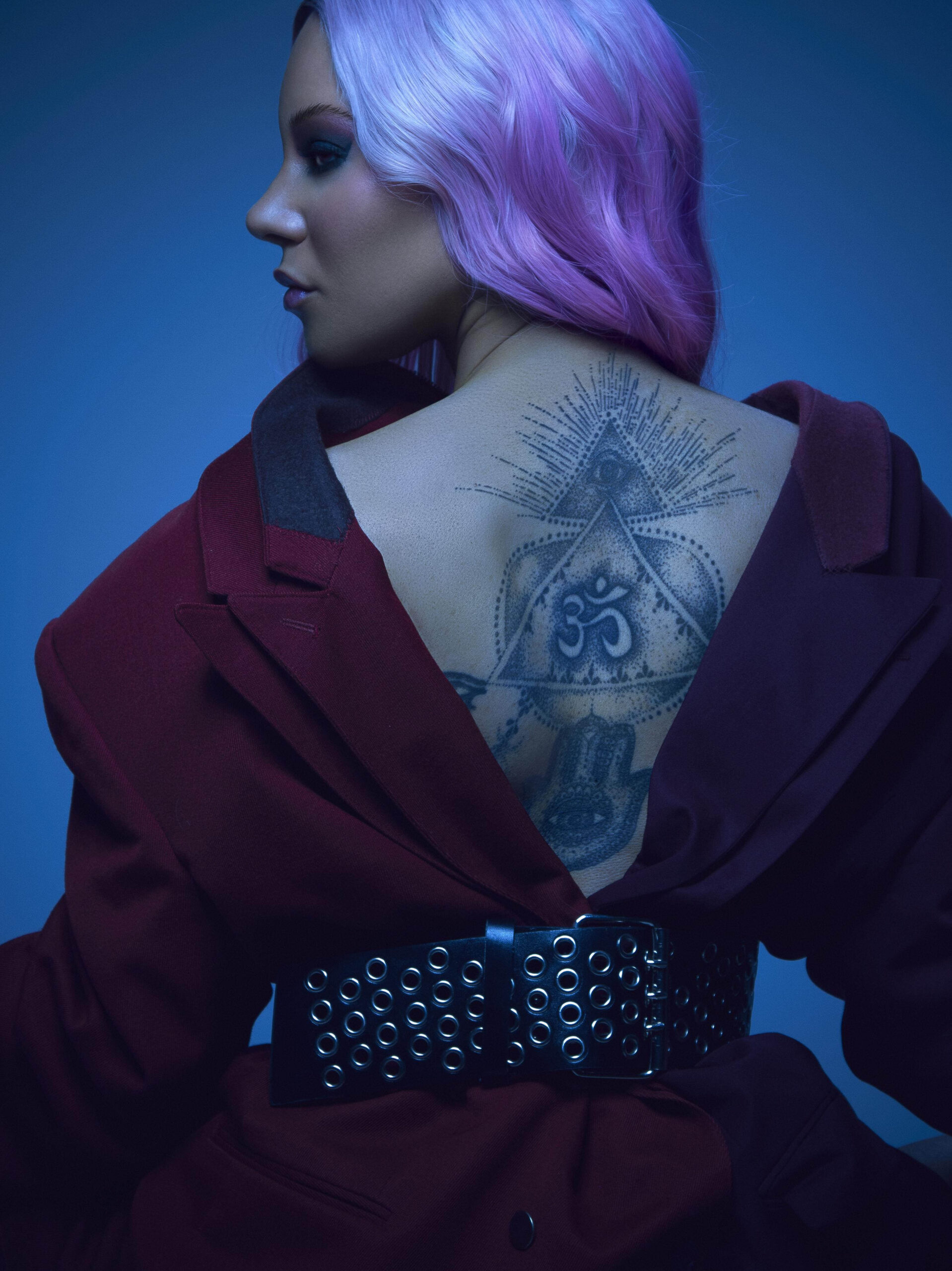
Munroe Bergdorf has been having a very good year. Just last month, she not only numbered among the Dazed 100, which recognizes the new faces of youth culture, but was also awarded Disrupter of the Year at the Cosmopolitan Influencer Awards. The London-based activist and model had her breakout moment last year when L’Oreal signed her to be the first transgender face of the cosmetics brand before swiftly dropping her for voicing some unflinching truths on institutionalized racism that went viral after Charlottesville.
“What happened with L’Oreal could have ruined by life, but I tried to make it as positive as I could,” Bergdorf tells Playboy. It turned out to be just her start. She continued to use her considerable online platform to uplift the trans experience, and today, her documentary, What Makes a Woman, a chronicle of her journey through facial feminization surgery, airs in the United Kingdom. At a time when trans women are witnessing more visibility than ever, the demographic is still facing violence and dehumanization in all corners of the world. On the eve of the premiere of her eye-opening documentary, Bergdorf spoke with Playboy on the hurdles trans women continue to face and the ever-shifting meaning of womanhood.
__
To address your most recent controversy, last week, you appeared with Caitlyn Jenner on the U.K. program Genderquake where you were heckled by a female audience member with transphobic comments. What was your biggest takeaway from the experience? Do you regret doing the show?__
The program highlighted where a lot of transphobia comes from. When we think of transphobia we think of this big seven-foot man, a skinhead, but that’s not really where it all comes from. Each day, there are women who don’t understand that trans women gaining rights isn’t a detriment to the rights of cisgender women at large. The show highlighted that very well and gave us a platform to speak out against it. I’m glad I did the show, and it’s unfortunate that it went that way, but what happened is very indicative of the conversations happening on television and in social media. There just seems to be a lack of respect. Even if you don’t understand who trans people are, we’re people. Speaking to us in a derogatory way says more about those people than it says about our community.
A lot of people are none the wiser that this is even a thing—that there are feminists who believe that trans women aren’t women, and their progress is a danger to women. There are no statistics that show trans women are a danger to anyone, in fact, we are the ones in danger more than anyone else. The life expectancy of a trans woman of color is 35. Two out of five people in the U.K. who are trans have experienced a hate crime. Eighty-five percent of trans kids have attempted suicide or self-harming.
What is the biggest lesson you took from the making of your documentary?
The world community needs to engage with each other. In recent times, we’re living in echo chambers, and algorithms keep us in those echo chambers. For example, not everyone in the U.N. agrees with each other or has the same beliefs, but there’s a respect there and diplomacy there that gives a common ground. We can’t even reach a respectful debate because there’s an emotional shutdown. The gender conversation involves us all, it’s not just trans people. It’s about pushing forward identity and showing how none of us are above society, none of us are above identity. To say the gender debate is just about trans people is shortsighted, especially when we consider that identity is on a spectrum—it’s not binary. It’s really going to get people thinking about the question presented in the title. There isn’t necessarily a definite answer, but it’s going to get people thinking about their own identity.
Who is your audience for the documentary? Who do you make this for?
My main objective was to make a bit of programming that didn’t patronize the queer community or the LGBT community, but also educated people who aren’t in that community. It’s a very fine line we’re walking, but I feel we respected it. I want a trans kid in the middle of England, in the middle of the countryside, to see this show and feel empowered by it. In the same blow, I want their parents to feel they’ve been educated. I do feel we achieved that.
I was also very adamant about the majority of the people being female or female-identifying. I feel we couldn’t make a documentary called What Makes a Woman and cater to the male gaze. The director is female, the majority of the crew is female. Everyone down from the producer is female. It really is a special project, and I’m grateful I got to be not only the subject but the arranger and presenter.
What about your life has changed since you had facial feminization surgery?
I actually feel more myself than I ever did. When I looked in the mirror [prior to the surgery], I had this feeling of ‘who is that person?’ I just didn’t recognize myself. It was a dissociative kind of experience. But now I look at myself in the mirror, and I’m like, that’s me. I understand that not everyone wants to have surgery, and that surgery isn’t an integral part of the trans experience. It’s all about identity. But for me, this was a surgery I had wanted for seven years. There was no doubt in my mind that I wanted it, and it helped me by leaps and bounds with gender dysphoria.
You recently covered your self-harm scars with a tattoo of you as a superhero. Does this represent a turning point for you?
My friend, Emily Malice, she’s an amazing tattoo artist, and she works at this all female-run tattoo studio called Femme Fatale. I wanted to cover up my self-harm scars. But I wanted it to be in a way that doesn’t really cover them up, but embraces them and depicts me in the form I’m in now—empowered, intelligent, beautiful, present. I was really mindful that I didn’t want to cover them up. You have to embrace all that you’ve been through so you can get through to the next stage of your life. [The scars] were from a really bad stage of my life, and I consider this to be the best stage of my life. The main thing I want to focus on is being a voice for my community and making sure I never lose sight of why I’m doing that I’m doing, using the platform I’ve been given for positive change.
“Media visibility is getting better, but there are so many issues still going on. We need to be mindful of the bubble we live in. “
What is the biggest challenge facing transgender women today, particularly transgender women of color?
Where do I start? I think it’s allyship. I don’t think there are any groups of people in history who have become empowered or liberated without allyship. We need people in privileged positions to start batting in our corner. I want people of influence to start stepping up. If you look at Drake’s latest single [“Nice for What”], he has the voice of a trans woman of color, but she’s not in the video. Men, especially, need to stand up for us because it’s men who are killing us. The more men that express that trans women aren’t a threat to one’s masculinity whatsoever, that will help push things along. However, that’s just one concern out of many—there’s unemployment, homelessness, the list really goes on. The burden would be lifted somewhat if allyship was embraced.
With the heightened visibility of trans women in entertainment and pop culture, do you feel people can sometimes be lured into a sense of complacency around the violence that trans women face daily?
Absolutely. People are like, “Things are getting better, aren’t they? We’re on our way to utopia.” I’m like, no, not really. The number of trans women in the U.S. who are committing suicide or being murdered goes up every single year, so things definitely aren’t “getting better.” Media visibility is getting better, and that’s great when it comes to empowering the future generation into believing their identity isn’t going to limit them. But there are so many issues still going on, and we need to be mindful of the bubble we live in. You go to some places in South America and trans women are literally being murdered in the street. What happens in other places around the world is our problem too. I don’t think we can say the gay men in Chechnya, “That’s their problem.” It’s going to take all of us coming together.
“We’re living in echo chambers and algorithms keep us in those echo chambers. None of us are above identity.”
During your transitioning journey, who were your role models?
I really had to look for them. When I was looking into Stonewall, [I learned about] Marsha P. Johnson and Sylvia Rivera—two trans women of color who started the riots and faced pushback from the gay community then that felt trans rights were below gay rights. She was one of my first role models, and she died before I was alive. Another role model was Octavia St. Laurent from Paris Is Burning, she was a transgender model. I saw myself in her instantly because I wanted to model, and I wanted to transition. It was like looking into a mirror. Janet Mock, Laverne Cox, Carmen Carrera, [were other] trans women who really inspired me to start using my voice and create my own space. Also, Ines Rau [Playboy’s first transgender Playmate] is incredibly amazing. Why shouldn’t transgender women be seen as equally desirable? The female body is beautiful in all its forms.
When do you feel most sexy?
The most amazing thing about transitioning is I have a consistency with my feelings. Before I transitioned, there would be sparks of me feeling myself or feeling sexy, but now I basically feel sexy all the time. I know this sounds bold, but it’s something that I’ve worked for. I worked on my self-confidence, my self-image. Considering how I dealt with anorexia and gender dysphoria and self-harming when I was younger, I worked hard to see myself how I see myself now. I better feel sexy all the time. On a daily basis, I feel confident and assured, and I feel ultimately that confidence is sexy.
To end with the question presented in the title, what makes a woman to you?
I don’t think there’s one answer because there isn’t one kind of woman. If you look at all the different cultures, I don’t understand how you could think there’s one kind of woman. A black woman’s experience is different from a white woman’s experience is different from a South Asian woman’s experience is different from an indigenous woman’s experience. That filters into identity. What someone is assigned at birth isn’t necessarily how they’ll identify at 25 or 35. Even if we don’t answer the question, the conversation is the most important part.