A naked body in public is taboo. In Western society–particularly in American culture–to reveal that which lies beneath our thin cloth barriers is to transgress puritanical Christian norms of hiding the self, that which has the power to separate and unify. Our private parts are to be kept private.
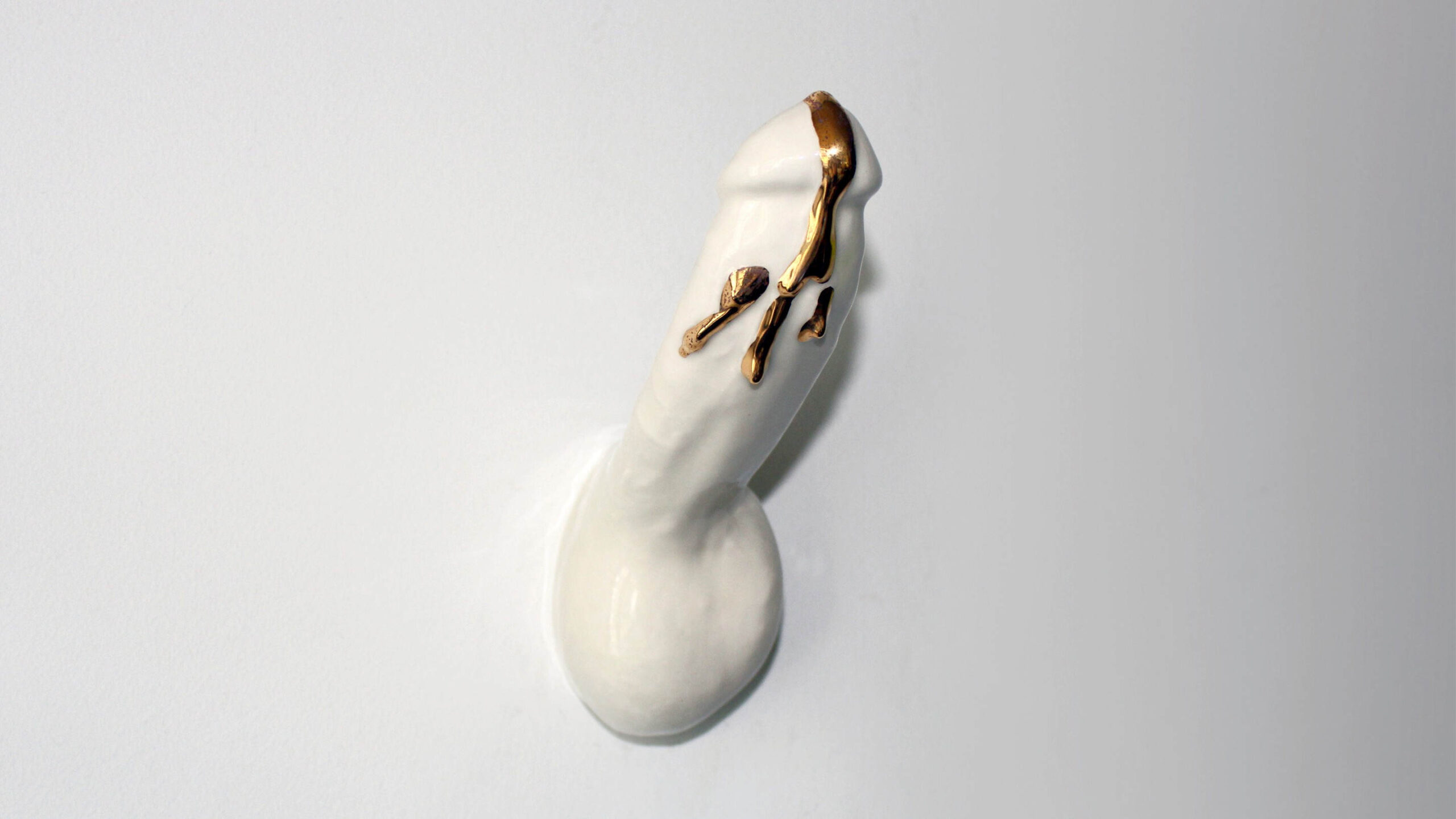
Art which displays the body can inspire similar reactions. Regardless of how transgressive or ordinary the work is, the baggage of the unclothed body remains heavy at the hand of art. In sculpture, these manifestations of the body thrill by bringing the body out of the bedroom and into the real world. From Mia Westerlund Roosen’s nipply American Beauties to Ettore Sottass’s phallic Shiva vase, sculpted genitalia questions and pushes viewers, bringing bodies together to both smother and celebrate that which we’re trained to hide.
Today, a fleet of artists across the country (and world) are manifesting unclothed bodies as a means to question norms, progress sex positivity, and articulate queer experiences. “Historically, naked bodies have been used within sculpture as symbols that reiterate how structures of power become distilled within certain bodies,” artist Alice Lang shares with Playboy. “I am interested in using the nude to tap into this historical symbolism (the female nude as desire, male nude as powerful) in order to subvert and confuse these ideas.” In Lang’s practice, she uses 3D scans of her own body to create anatomically correct mugs. Effectively, Lang is undoing centuries of morphed bodies being iterated as “real bodies” as well as responding to personal experiences with being objectified. Lang explains: “These works explore my attempt to gain some kind of agency within what a female body continues to represent which I think is a somewhat universal experience for many women.
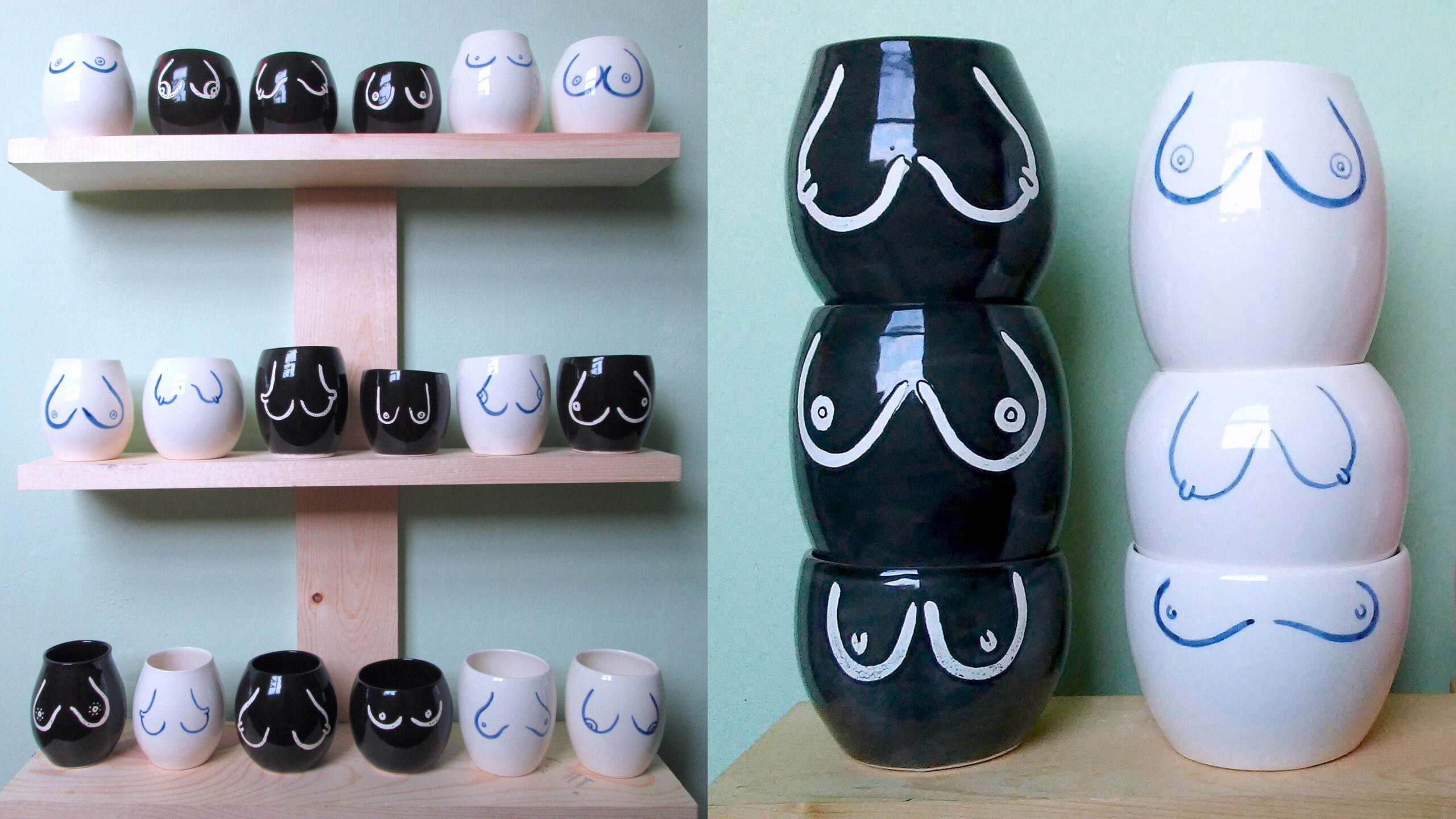
”Sexual ceramics do more than show off the bare, but instead highlight the autonomy of and equity of bodies–and stress feminist ideologies while looking outward, at myriad social issues. Yes, sexual ceramics can be “sexy,” but their intentions can also be more political. Eliza Fernand feels that political commentary is integral to her work, specifically via pieces like her Lovely Breast vessels. “I often think about how male chests can be publicly exposed but female chests are illegal,” Fernand says. “When I look for images of breasts online, I don’t see a true representation of the full spectrum of female forms. I want to put more true imagery into the world.” Fernand’s work has resonated with many who feel the same too since many viewers have shared their experiences in the hopes expanding representations in her practice. “I have had a few women give me drawings or photographs of their breasts so that I could make a custom pot to represent them,” Fernand says. “I see it as a celebration of the self, and a second-hand way to expose the parts of us that have been forbidden because the patriarchy can’t handle our bodies.”The political nature of these works may be omnipresent but it doesn’t erase the sometimes humorous or ironic. Artists like Jeremy Brooks manifest the body to draw connections between the public and private, pointing out the similarities of both environments. In ceramics, the connection is quite clear. “To most, a cup might not seem to be an obvious form to depict something sexual,” Brooks explains. “However we perform one of our most sensuous acts through its use: pressing our lips to the rim of a cup shares a strong parallel to that of a soft kiss.”“What we routinely expect and experience through ceramics in our daily lives is what I strive to challenge,” Brooks says.
Of course, the tension between these often functional, everyday objects with our physical selves is inherently fun since—well—naked bodies are fun. This is what Meegan Barnes considers in her practice as her curvaceous forms are rarely objectified but often giggled at and applauded. “Most people laugh and love it,” Barnes shares. “Other people read racial significance. Some moms shield their kids’ eyes…I think their reaction reveals their truth, issues and/or sense of humor. To me, it’s a fun celebration of one of mother nature’s greatest gifts.”
To balance out the political and playful ideologies of sexual ceramics, one community is squarely in the middle of this conversation: queer artists, whose sexual and gender identities are explored in this form of ceramics. Many of the artists Playboy spoke with stressed that their sexual creations are tied to queer identities and that they are attempts to address bodies in society as well as articulating experiences across the LGBTQ+ spectrum. Take Caitlin Rose Sweet’s ceramic practice. “My work is sexual,” Sweet says. “It’s not just sexy but it’s about how sexuality and pleasure bring people together. Sexuality is scarred and needs to be honored. My ceramics are ritual objects that can be used alone or shared between people. It about making a connection.” Sweet describes her functional ceramics like vaginal pipes and breasted bud vases as celebrations of queer bodies that recall her own experiences as a queer woman but also incorporates others in her community. (Sweet notes she’s working with a trans friend to include more “diverse, inclusive bodies.”) “Its meta!” she tells Playboy. “I use my haptic knowledge of surviving and thriving in a heteronormative world to make functional pieces that help others celebrate and connect with their personal bodily power and knowledge.”
Duo Pansy Ass have a similar playful approach and use their expansive practice to not only represent queer sex but to question very elementary views of sex. “There is still a lot of tension and shame associated with bedroom activities that aren’t seen as vanilla or a straight couple in the missionary position,” they share. “We make these objects to indirectly help alleviate and reconcile this shame and because sometimes these of objects are downright silly and there’s a bit of humor associated with ‘getting off’…We try to present these themes of desire, the body and sexuality in objects that are beautiful and can be displayed and used with pride, helping to create spaces that reflect underrepresented identities.
”Much of this is accomplished by kitschy commentary and tapping into decades of Western homemaking. Anna Joan Taylor links these forms to conversations of sexual and queer freedoms: sexual ceramics can lubricate conversation of identities by directly pulling from domesticity for inspiration. “I draw on the decorative as it is tied to feminist labor and movements,” Taylor says. “The decorative, for me, plays far more seriously into female and femme expression, a history of women being relegated to the decorative arts as their only means of artistic outlet.”
“It’s not just sexy, but it’s about how sexuality and pleasure bring people together. Sexuality is scarred and needs to be honored.”
As sexual ceramics expand the minds of viewers as it relates to identities on display, it’s necessary for the practice to critique in both directions. Ron Geibel work evokes male genitals (as well as sex toys like butt plugs and dildos) through very intricate and delicate executions. The intention is not to honor these forms but to question them. “The highly crafted cones with multiples are in part commentary on the way pockets of gay male culture are obsessed with physical appearance, sculpted bodies, and, well, manicured everything,” Geibel says. “The highly considered, obsessive placement of each tiny wheel-thrown form is a direct response to my own struggle with a regimented, controlled existence.” This explosion of presumed queer bodies goes further for artists like Aimee Goguen who hope to dismantle presumptions of what these “private parts” can be. Goguen creates literally handy phalluses that are both used in the creation of larger sculptural works but also sold and shared as literal knobs and baubles. For Goguen, her works are about “transforming sexual energies” and “transmutating the body.”
As Goguen riffed poetically by email, she explained the form: The shape shifting dick is fast and hard shape shifting. At first the shape is simple. A shape we learn about in early math. In our childhood. We see the shape but we don’t feel the shape. Shape shifting square dick to pentagon dick to octagon dick or rhombus dick to dodecahedron dick to pentagonal trapezohedron dick.. disgusting. And then back to a square or circle. The shape shifting dick is fast and hard shape shifting inside my mouth or butthole. The shape shifting dick is that game you play of the bathtub. Washing off the geometry.
While Goguen’s thoughts continued on, the underlying message is about deconstructing the phallus, to make it a more populist, non-male form: she is queering the body. As Goguen puts it, in response to a question about the importance of unclothing the body in ceramics, the answer lies somewhere “when you fuck your own hole with your own dick.” Clearly, sexual ceramics have endless edges and angles.
More than novelty, more than fun, more than sex appeal, the expanding world of sexual ceramics isn’t as simple as putting plants in a mammary vase or getting all giggly about a penile pot. These works, like the artists that are making them, are doing a lot more intellectually than making someone snigger. Sexual ceramics are not just of and about the body but are about society and the ways in which our world tries to contain expressions of desire and difference. To behold sexual ceramics isn’t simply for gawking at private parts: it’s an attempt to untangle the many ways in which the Western world is attempting to hide difference in plain sight.